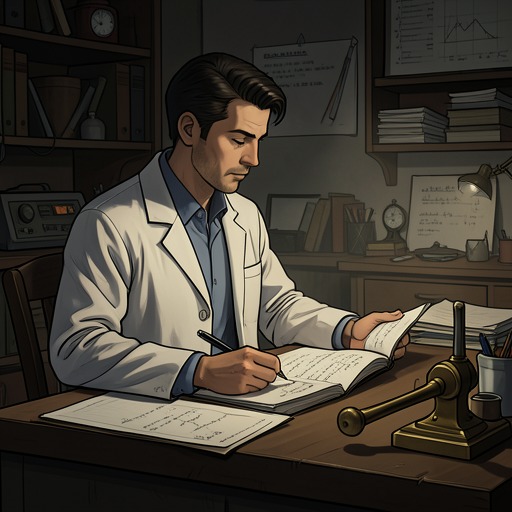
Andrew Martin proves the Riemann hypothesis
The HumansAndrew Martin proves the Riemann hypothesis in a breakthrough that the Alien narrator later verifies in the file called Zeta proof file. The proof marks the boundary of human mathematical knowledge being crossed—and sets in motion the hosts’ effort to suppress the discovery and its evidence.
The breakthrough at the desk
Five minutes before midnight, Andrew Martin was sitting at his desk, staring at his computer screen and drinking black coffee. The narration leaves one detail deliberately uncertain: he may or may not have jumped from his chair when the breakthrough came. What is certain is the scale of the moment: his mind had reached a place no human mind had reached before, at what the narrator describes as the very edge of knowledge.
The achievement was not simply a promising approach. The narrator says that shortly after the breakthrough the hosts took Andrew Martin, and that he himself met him only briefly. The reading made of Andrew was physically complete but mentally incomplete: cloning could reproduce a human brain, the narrator explains, but could not reproduce much of what was stored inside it. The proof’s discoverer was therefore removed from the story just as the narrator began trying to understand the life and discovery he had inherited the task of containing.
The proof in Zeta proof file
Later, in an office lined with books and crowded with papers, the narrator found a computer and quickly located a document called Zeta proof file. It ran to twenty-six pages, mostly mathematical symbols, with a short written introduction identifying it as a proof of the Riemann hypothesis. The narrator worked through the numbers, graphs, and symbols, treating mathematics as a language he had to learn.
The decisive confirmation came at the document’s end. After the final, conclusive infinity symbol, the narrator was left in no doubt that the proof had been found and that the key had turned the lock. This retrospective verification distinguishes the event from a mere claim of discovery: the proof was complete, even though the narrator had not been present for Andrew Martin’s breakthrough itself.
Stakes and suppression
The novel places the discovery against a long mathematical pursuit. Other major riddles, including Fermat’s Last Theorem and the Poincaré Conjecture, had been solved, leaving the Riemann hypothesis as the last and largest problem. Its solution is associated with consequences reaching beyond mathematics: the prospect of supercomputers, explanations of quantum physics, and interstellar transportation. These are presented as what the breakthrough could ultimately enable, not as developments already achieved.
The narrator’s response turns recognition into suppression. Without hesitation, he deleted the document, taking a small rush of pride in the act because his mission was to halt progress and destroy evidence of Andrew Martin’s breakthrough. But the proof’s traces were not confined to computers: the narrator understood that they also lived in human beings. The deletion therefore could not make the consequences simple or complete; the discovery had been established, while the effort to erase it became a separate and consequential part of the story.